Search This Blog

Tuesday, 24 June 2014

Na het einde van de Almere Icedôme als toekomstige schaatstempel van Nederland: werd er nu wel of géén overheidssubsidie gevraagd aan de gemeente Almere?!

Vandaag schrijf ik weer een eenmalig artikel in het Nederlands, omdat het onderwerp – de Almere Icedôme – mij als Almerenaar zo na aan het hart ligt. 

Op 4 juni van dit jaar – ruim twee maanden ná het verstrijken van de officiële deadline voor het volledig rondkrijgen van de financiering en de exploitatie van de Icedôme – werd het spijtige nieuws bekend gemaakt door NOC/NSF en de KNSB, dat de Almere Icedôme zich definitief niet gekwalificeerd had als toekomstige schaatstempel van Nederland:

De schaatsbaan Icedôme in Almere wordt toch niet de nieuwe schaatstempel van Nederland. Het consortium achter de baan heeft niet de benodigde middelen bij elkaar gekregen 'om de afgesproken zekerheden te kunnen leveren', zo liet sportbond KNSB vanmiddag weten. Volgens het consortium bestaan er onzekerheden over zowel financiering als exploitatie, zo schrijft het op Facebook.

Daarom hebben sportkoepels KNSB en NOC*NSF de samenwerking met de Icedôme beëindigd. Zowel de twee bonden als de Icedôme zelf betreuren dat het zo is gelopen, staat in een verklaring.

Ik heb vorige jaar een aantal artikelen geschreven (lees bijvoorbeeld dit artikel en dit)  over de Almere Icedôme: onder andere het verslag van een exclusief interview van Ernst’s Economy for You met Folkert Buiter, die samen met ex-schaatser Jakko Jan Leeuwangh de ontwikkelaar en stuwende kracht was achter de Almere Icedôme.

Hoewel er op dit moment door het consortium – met hierin de bouwondernemingen Royal BAM Groep NV ($BAMNB) en Van Wijnen Groep N.V. – officieel nog steeds wordt doorgewerkt aan het project Almere Icedôme, lijkt dit toch vooral een achterhoedegevecht te worden.

Ik betwijfel dan ook of het project ooit de tekentafel zal ontstijgen, temeer daar BAM in haar jaarverslag had aangegeven minder aan het voorfinancieren van projecten te willen doen, vanwege de financiële risico’s van zulke projecten, alsmede het afbreukrisico voor het bedrijf. Persoonlijk vind ik dit een buitengewoon spijtige ontwikkeling, maar onvermijdelijk, gezien de gang van zaken van de laatste maanden waarin geen enkele voortgang werd bereikt met betrekking tot de bouwfinanciering en de exploitatie van de Icedôme.

Er zat mijzelf echter één ding dwars, na het definitieve afblazen van het Almere Icedôme project als toekomstige schaatstempel. Tijdens het interview met Folkert Buiter, heeft deze mij tot twee keer toe bezworen dat er geen enkele sprake zou zijn van staatssteun of gemeentesubsidies tijdens de bouw van de Icedôme.

Hij zei dit zo in het eerste deel van het interview:

Ernst: Draagt Almere als gemeente nog kosten bij?

Folkert: Dat mag niet en dat willen wij niet. De gemeente moet het bestemmingsplan uitwerken en onderzoeken doen. Almere moet de te leveren grond bouwrijp maken en ontwikkelen, omdat een gedeelte ook openbaar blijft. Wie het beheer gaat doen, moet nog uitonderhandeld worden.

Almere kan gebruikers en verenigingen steunen met prestatiesubsidies en startsubsidies, maar dan wel binnen de regels van de wet. Het subsidiëren van maatschappelijk belang kan plaatsvinden zonder strijdigheid met EU wetgeving en de Wet Markt en Overheid.
Ik ga er vanuit dat Almere er belang bij heeft om een universiteit te faciliteren, alsmede het Centrum Topsport en Onderwijs (CTO) en allerlei faciliteiten voor top- en breedtesport te steunen, maar dat zijn maatschappelijke subsidies: prestatiesubsidies. Dat helpt organisaties soms over een drempel heen.  Als zoiets als schoolschaatsen door de ouders zelf moet worden betaald, dan gaat dat haast niet zonder steun.

En in het tweede deel van het interview kwam hij daar desgevraagd nog wat uitgebreider op terug:

Ernst: De grondprijzen die Almere vroeg [ca. €15 miljoen - EL]: zijn dat marktconforme prijzen?

Folkert: Dat zijn de grondprijzen die de gemeente er voor vraagt. Zij hanteren in hun grondprijsbeleid een bepaalde bandbreedte voor grondprijzen, vastgesteld door de gemeenteraad.

Ernst: En daar zit geen stiekeme subsidie in?!

Folkert: Nee, het is allemaal verifieerbaar, omdat het allemaal openbaar wordt gemaakt na een besluit. Wij betalen de grondprijs, maar wij verwachten dan wel dat Almere de grond bouwrijp maakt en heel goed inricht. Daar heeft de gemeente zelf ook belang bij.

Nu al hebben partijen zich gemeld, omdat de Icedôme Almere er komt en er daarnaast een retailpark wordt aangelegd: bedrijven, organisaties voor sport etc. Daardoor heeft de Icedôme als project een enorme spin off voor de gemeente.

Echter, gemeentes mogen uitsluitend maatschappelijke belangen subsidiëren; iets dat wij niet zijn. Wel kunnen ze de sporten subsidiëren die van onze faciliteiten gebruikmaken. De gemeente kan daarnaast ook een business paviljoen nemen en dat doen ze waarschijnlijk ook. In de business en exploitatie spelen ze echter geen rol.

Ernst: Loopt de gemeente nog enig risico gedurende de bouw- en exploitatiefase?

Folkert: Als de handtekeningen door de relevante partijen eenmaal zijn gezet, helemaal niet meer.

Ernst: Ook niet in de vorm van bankgaranties en verpandingen, waarbij ze als contragarant optreden?

Folkert: Nee, dat is ook ongeoorloofde staatsteun. Dat mag helemaal niet. Wij willen geen last hebben van discussies over staatssteun. Alles wat we kunnen krijgen omdat het mag: graag! Ook maatschappelijke subsidies voor sportverenigingen die onze klanten worden en voor onze overige partners: be my guest. Geld gaat daarheen en komt dan indirect bij ons. Maar dat is geoorloofde staatssteun: dat is toegestaan.

Ernst: Maar er is dus geen enkele vorm van garantie of garantstelling door Almere?!

Folkert: Nee, dat moet ook niet.

Folkert Buiter leek mij een man van zijn woord en ik geloofde hem daarom ook, toen hij mij zo duidelijk bezwoer dat er geen enkele sprake zou zijn van gemeentesubsidies of staatssteun.

Tot mijn verbazing zag ik echter op 11 juni in het lokale weekblad ‘Almere Deze Week’ het volgende citaat staan, naar aanleiding van uitspraken gedaan door wethouder Henk Mulder van Almere:

Wethouder Henk Mulder van Gemeente Almere
Foto gemaakt door: Ernst Labruyère
Klik erop om te vergroten.
Wethouder Henk Mulder is teleurgesteld in de ontwikkelingen. Hij liet weten dat het consortium de gemeente verzocht heeft financieel aan het complex bij te dragen. Dat was voor de gemeente onbespreekbaar, zo liet ook burgemeester Annemarie Jorritsma weten. Het is ontzettend jammer dat het consortium het niet voor elkaar gekregen heeft. Wij hebben als gemeente het initiatief altijd gesteund, maar ook altijd benadrukt dat het om een particulier initiatief gaat en dat we er als gemeenschap geen geld in willen steken. En aan die afspraken houden wij ons.

Het nieuws dat het consortium bij de gemeente om steun heeft gevraagd, is opmerkelijk. Initiatiefnemer Folkert Buiter liet weten wel drienhalf keer de benodigde financiën te kunnen binnenhalen. Er zouden zelfs al plannen zijn om naast Icedôme Almere een complex te bouwen dat raakvlakken had met de ijstempel.

Omdat het nieuws van deze lokale krant zo in tegenspraak was met wat ik van Folkert Buiter zelf had gehoord, heb ik in eerste instantie twee partijen om een officiële reactie gevraagd: 

Folkert Buiter gaf in een mail aan, dat hij door medische omstandigheden niet in staat was mijn mail uitgebreider te beantwoorden.

Hij verwees mij daarom door naar CEO Cees van Bemmel van het Baarnse bouwbedrijf Van Wijnen, die daarnaast ex-wethouder van de Gemeente Almere is, namens de VVD (Portefeuilles Financiën, Grondbedrijf, Stadscentrum, Sport en Vinex Onderhandelingen).

Desgevraagd reageerde de directiesecretaresse van CEO Van Bemmel van Van Wijnen met de volgende zin:

“Namens de heer Van Bemmel deel ik u mee dat wij geen mededelingen doen over het project”.

Gelukkig kreeg ik wel een veel uitgebreider antwoord op mijn vragen aan wethouder Henk Mulder van Almere.

Projectdirecteur van Almere Poort, F. van Deursen, reageerde met het volgende uitgebreide antwoord:

Pagina 1 van brief Gemeente Almere
Brief in het bezit van: Ernst Labruyère
Klik erop om te vergroten.

Pagina 2 van brief Gemeente Almere
Brief in het bezit van: Ernst Labruyère
Klik erop om te vergroten.

‘Na 1 april jongstleden bleek in gesprekken met het Consortium dat het zonder actieve financiële ondersteuning vanuit de overheid, waaronder de gemeente, niet zou gaan lukken om aan de eisen van de KNSB en NOC/NSF te voldoen. Het Consortium heeft de gemeente vervolgens om een financiële bijdrage verzocht. In gesprekken op ambtelijk en bestuurlijk niveau is daarop verkend hoe binnen de gestelde randvoorwaarden van eerdere collegebesluiten (geen risicodragende participatie in financiering of exploitatie) en de bestaande mogelijkheden het project kon worden ondersteund.

Naar aanleiding daarvan is door de gemeente aan het Consortium aangegeven dat de gemeente in staat is door middel van een aantal maatregelen bij te kunnen dragen aan het haalbaar maken van het project. De maatregelen zouden liggen op het terrein van het uitgeven van de grond in erfpacht, het toepassen van stimuleringsmaatregelen, werkgelegenheidssubsidies en het bouw- en woonrijp maken. Omdat dit uitgangspunt van de gemeente vooraf helder was, is niet gesproken over een subsidie. Voor wat betreft staatssteun geldt dat wanneer overheidssteun gemeld en getoetst wordt in Brussel, met toestemming, bepaalde vormen van overheidssteun mogelijk zijn. Ook bij de provinciale steun aan de vernieuwbouw en renovatie van ‘Thialf’ is dit bijvoorbeeld het geval en is goedkeuring verkregen uit Brussel’.

Uit deze correspondentie blijkt maar weer hoe lastig het is om een dergelijk project als de Almere Icedôme winstgevend te krijgen op de lange termijn. 

Ook blijkt achteraf hoe terecht mijn vragen van oktober vorig jaar aan Folkert Buiter zijn geweest, over het verstrekken van subsidie en overheidssteun door Almere. En dit, terwijl Buiter op dat moment nog dacht dat het Icedôme project ruimschoots gerealiseerd kon worden zonder subsidie.

Gezien het soms twijfelachtige verleden van de gemeente Almere met ambitieuze bouwprojecten – zie bijvoorbeeld Het Kasteel van Almere – respecteer ik de beslissing van de gemeente, om geen gemeentesubsidie te verstrekken voor de bouw van de Icedôme, zeer.

Dit gelezen hebbende, ga ik er van uit dat binnenkort het doek zal vallen voor de Almere Icedôme, omdat het definitief onmogelijk zal blijken een dergelijk groot project zonder overheidssteun te realiseren. 

Dit temeer, omdat de belangrijkste ‘klanten’ van de Icedôme NOC/NSF en KNSB op 4 juni hun opdracht inmiddels hebben ingetrokken. 

Dit is een zeer spijtige, maar schijnbaar onvermijdelijke ontwikkeling.

Monday, 23 June 2014

Dutch statistical bureau CBS shows clear signals of an improving Dutch housing market in May, 2014. This could be the beginning of the end for the Dutch housing crisis, which started so covertly in 2006. Nevertheless, don’t raise the flag yet!

During the last two years, I wrote few articles about the Dutch housing market.

The main reason was that there were many other interesting topics to write about, while the Dutch housing market itself showed little change and improvement during the last few years. Besides that, I felt that I had said almost everything that needed to be said about it and I did not want to repeat myself.

Still, last Friday the Dutch Central Bureau of Statistics (www.cbs.nl) came with the ‘good’ news (for sellers; not for buyers), that the Dutch housing market in May, 2014 had improved in comparison with last year: not only the sales had increased dramatically year-on-year, but even the housing prices were (slightly) up.

Here are the pertinent snips of the CBS press release:


Prices of owner-occupied houses, excluding new constructions were on average 1.4% higher in May 2014 than in May 2013. In April 2014, the first year-on-year price increase (0.1%) in 5 years was recorded.

Prices of owner-occupied houses have been stable for more than a year now and are at approximately the same level as in early 2003. They were 20% below the record level registered in August 2008. 

Sales of owner-occupied houses continue to rise. In the first five months of this year, 51,709 homes were sold, an increase by more than 36% relative to the same period last year.

For people, whose mortgage is under water (i.e. the remaining loan sum is higher than the market value of the collateral house), this is particularly good news.

Now these people have an outlook to earn back some of the (paper) losses on the value of their home. And on top of that, the improved sales numbers mean that it will be slightly easier to sell their house within a reasonable period of time.

Still, I advice you to not raise the flag yet!

On 1 July 2014, the ceiling amount for the Dutch ‘National Mortgage Guarantee’ or NHG – a guarantee from a semi-governmental organization, which protects houseowners against residual debt, in case of an involuntary housing sale – will be substantially reduced to €265,000 from the current €290,000:

As a consequence of this reduction [of the NHG guarantee ceiling amount], many future buyers could miss a discount on the interest rate to the tune of 0.7% for a mortgage loan with a ten year fixed interest rate. This will increase the monthly payments for a €250,000 dwelling with €100 to €150 per month.

In my humble opinion, the increased housing sales and slightly higher housing prices during the first five months of 2014, do not come as a surprise.

I think that many people grab the opportunity to make a ‘last minute’ buy of a house with an NHG guarantee at the current €290,000 ceiling amount: especially the people whose designated house lies within the price range of €265,000 -  €290,000. 

Consequently, the true benchmarks for 2014 will be the housing sales numbers and housing prices in July and the remainder of this year. Afterwards we will have a better overview, whether the Dutch housing market indeed improved in 2014, or that the improvements have been (again) the results of government intervention in the Dutch housing market.

Besides that, one should remember that the price level of Dutch dwellings has returned to 2003 levels (see the red and bold text), while the current average interest rate on mortgages is 1.3 % (!) lower than in 2003. This shows what an enormous beating the Dutch housing market bore during the last six years.

To spice up this article, I have created a few charts of the Dutch housing market, based on data from the Central Bureau of Statistics and Dutch national bank De Nederlandsche Bank (i.e. average mortgage interest rates).

These charts show the price index and sales numbers, during the last 20-odd years and also – on the following chart – the influence of the interest rate on the average housing price and sales numbers:


Number of sold houses (moving average) and the indexed
housing price vs the average mortgage interest rate
Chart by: Ernst's Economy for You
Data courtesy of: www.cbs.nl and www.dnb.nl
Click to enlarge
For me this particular chart is very interesting, as it shows a few clear correlations.

As I mentioned earlier at this site, the Dutch housing crisis strongly accelerated after the start of the credit crisis in 2008, but it is not caused by the credit crisis, even though this is a popular myth.

In January 2006, the average interest rate on mortgages started to rise strongly again, after being in a record-low trough for about a year. This had the following consequence: after hitting record sales in January 2006, the average housing sales number started a period of steady decline, which lasted until 2013: a mindboggling seven years.

On top of that, after the mortgage interest rate hit peak level in September 2008, the housing prices also started to decline. This price drop has lasted until April 2014, in spite of the record low interest levels since September 2013.

The indexed housing prices and quarterly
sales of Condominiums (1995 = 100)

Chart by: Ernst's Economy for You
Data courtesy of: www.cbs.nl
Click to enlarge

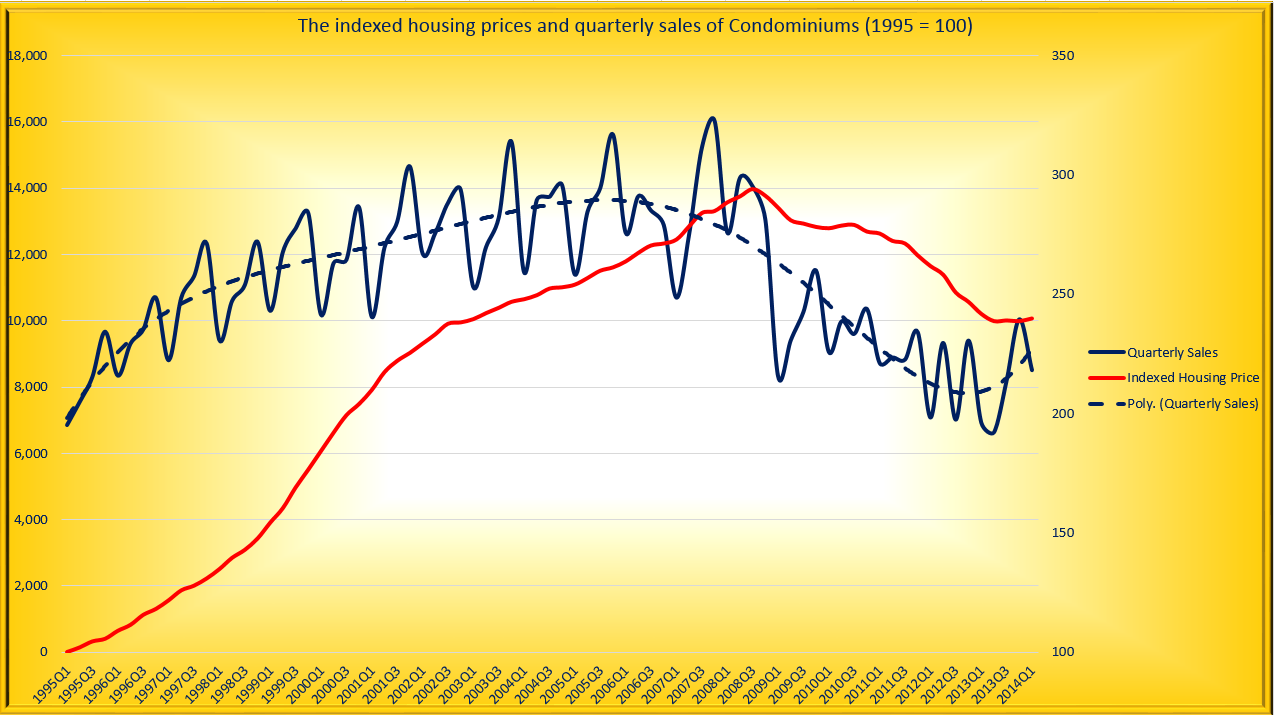
This particular chart shows that the price of condominiums has risen sharply since 1995: with 194%. However, the decline of prices, since the highest price level was reached, has only been 22.6%. This brings the proportion between the pre-crisis price increase and the subsequent post-crisis price drop to a record 8.6.

The reason that the price decline for condominiums has remained fairly low is – in my humble opinion – that most condos are relatively cheap ‘social’ houses. 

Unsubsidized rental houses in the same category became much more expensive since 2008: see for instance the chart in this article, which shows housing rent raises versus the official inflation rate in The Netherlands since 1989. 

This means in reality that a cheap owner-occupied condo or house-in-a-row is often much less expensive than a rented house in the same category: even at the current, still high housing prices. This is the reason that you see a similar phenomena at the houses in a row:

The indexed housing prices and quarterly
sales of Houses-in-a-row (1995 = 100)

Chart by: Ernst's Economy for You
Data courtesy of: www.cbs.nl
Click to enlarge
Since 1995, the average price of a house-in-a-row has increased by 169%, which is less dramatic than the price increase of condos. 

Nevertheless, the price drop since the highest price level has only been 20.2%. This brings the proportion between pre-crisis price increase and post-crisis price decline to 8.4 for houses-in-a-row, which is also very high in comparison with more expensive types of dwellings.

The indexed housing prices and quarterly
sales of Residential Houses (1995 = 100)

Chart by: Ernst's Economy for You
Data courtesy of: www.cbs.nl
Click to enlarge
Residential houses went through the most dramatic changes since 1995. 

In the years before the crisis, the average price of residential houses increased by a staggering 239%, but after the crisis started, the average price plummeted by 32.1%. 

This brought the proportion between pre-crisis price increase and post-crisis price decrease to 7.5, which is quite low. 

This means that both the price increase and price decline have been particularly dramatic for residential houses.

The indexed housing prices and quarterly
sales of Semi-detached Houses (1995 = 100)

Chart by: Ernst's Economy for You
Data courtesy of: www.cbs.nl
Click to enlarge

With 189%, the price increase of semi-detached houses was also quite high before the crisis, but so has the price decrease since the crisis started: 27.1%. 

The result of these changes is the lowest proportion between the pre-crisis price increase and the post-crisis decline: 7.0. 

Just like with residential houses, the price of semi-detached dwellings has suffered dearly from the crisis.

The indexed housing prices and quarterly
sales of Corner Houses (1995 = 100)

Chart by: Ernst's Economy for You
Data courtesy of: www.cbs.nl
Click to enlarge
As corner houses are also a relatively inexpensive kind of dwelling, the proportion between the pre-crisis price increase (178%) and the post-crisis price decline (22.9%) is also quite high: 7.8. This means that the price of corner houses has remained fairly stable after the crisis started, in comparison with the quite dramatic price increases since 1995. 

This makes sense, when you compare the fixed expenses per month of such a house with the price of a comparable house on the free (as in ‘unsubsidized’) rental market.


Summarizing, one can state that the Dutch housing market is indeed improving, with increasing housing sales numbers for all kinds of dwellings and even average sales prices, which are cautiously rising.

However, it is much too early to call it a day for the crisis on the Dutch housing market. 

Only after the NHG ceiling amount has been lowered on July 1st and the sales numbers and housing prices remain rising in the following months, we ‘might hear the fat lady sing’. Besides that, even then it might take years and years before the consequences of this ferocious Dutch housing crisis have been polished away.

The worst consequence for me of this improving Dutch housing market is, however, that the Dutch government might see the aforementioned positive developments as an encouragement to postpone further attempts:

  • to abolish the Mortgage Interest Deductability (MID) policy, which keeps housing prices at an artificially high level, due to the strong reduction of the net interest rate, which homeowners have to pay;
  • to make it slightly easier for Dutch citizens to get rid of their excess mortgage debt. Nowadays, it is almost impossible to get rid of excess mortgage debt or residual debt after an involuntary housing sale;
    • Even banks that blatantly overcredited people in the years before the crisis, hardly suffer from the consequences of their reckless actions.
This would mean that the utterly disturbing MID policy (for the Dutch housing prices) remains in place and that many Dutch citizens will remain slaves of their excess mortgage debt in years and years to come. 

What a shame!  

Sunday, 22 June 2014

Bernard Wientjes, chairman of employer’s organization VNO/NCW and ‘Most Influential Man in The Netherlands’ has been involved in a longterm, pan-European cartel, according to an official judgment of the European Court of Justice.

Bernard Wientjes, since 2005 the chairman of employer’s organization VNO/NCW, is arguably the most influential man in The Netherlands.

Wientjes is also vice-chairman of the SER (Social-Economic Council), which is a very influential advisory board of the Dutch government, as it binds the social partners: the employer’s organizations, the labour unions and the Dutch government.

Since 2005, when he started as chairman of VNO/NCW, Wientjes has always been an avid defender of: 
  • less regulation for companies in The Netherlands and the European Union;
  • a level playing field for all companies in the whole European Union.
Yesterday, however, the Dutch financial newspaper Het Financieele Dagblad (www.fd.nl) came with a remarkable scoop. Bernard Wientjes, as former full owner/ director of the manufacturer of shower cabin panels, Ucosan BV, had allegedly been caught with his hand in the cookie jar.

His company Ucosan BV and – after the takeover of Ucosan – its parent company Villeroy & Boch have been convicted by the European Commission, for being an important part of a long-term, pan-European cartel, concerning bathroom furniture and appliances.

This cartel had been in effect between 1992 and 2004. On 16 September 2013, this conviction by the European Commission has been sustained by the European 
Court of Justice.

The following snippets come from this remarkable FD article:

Wientjes was the executive director / owner of shower cabin panel manufacturer Ucosan in [Dutch city] Roden. In 1989, he sold half of this family company to Villeroy & Boch. Ten years later he sold the rest of Ucosan to the German company.

After this deal had been completed, Wientjes also became an executive manager at Villeroy & Boch. Until 2005, Wientjes was responsible for all bath room products of this company and he remained executive director of Ucosan as well, until 2003.

In 2010, the European Commission penalized Villeroy & Boch, and sixteen other manufacturers of bathroom furniture and appliances, with a penalty amounting to €622 million for making illegal price arrangements. The cartel had been active from 1992 until 2004, when the authorities raided these companies during an anti-cartel investigation.

Of the penalized companies, Villeroy & Boch was fined with the second highest penalty: approximately €72 million. Villeroy & Boch appealed against this penalty, but it was nevertheless fully upheld by the European Court of Justice, even though other accused companies saw parts of their penalties being withdrawn.

Normally, the European Commission publishes in detail the grounds for a cartel penalty. To the amazement of insiders in the matter, however, the publication of this bathroom cartel has been delayed for already four years.

The judgment, in which the European Court of Justice declines the objections of Villeroy & Boch against the penalty, quotes from the confidential penalty resolution by the European Commission. This quote contains a referral to the role of Bernard Wientjes, as well as his private company Wientjes Beheer (i.e. ‘management’), in this cartel case of Villeroy & Boch.

The European Court reveals, as a matter of fact, that Villeroy & Boch regards Bernard Wientjes as the sole perpetrator of Ucosan’s illegal price arrangements.

I have looked up this particular judgment by the European Court of Justice and – in spite of the stately, difficult legal language – there is not a single, unclear word in it, when it comes to:

  • a. the justification of the penalty for Villeroy & Boch, as full owner of Ucosan BV;
  • b. the fact that Villeroy & Boch sees former owner of Ucosan, Bernard Wientjes, as the main perpetrator in this cartel case. 

Here are the most important snippets of this whole must read, 50 page judgment by the European Court of Justice.

1104   Since 1989, Villeroy & Boch holds 50% of the stock in Ucosan, which is active in the area of shower cabin panels. On 1 November 1999, Villeroy & Boch acquired the remaining 50% of the shares in Ucosan, making Villeroy & Boch the single owner of this company.

Ucosan existed of Ucosan Holding BV, with a statutory seat in The Netherlands, which held a.o. 100% of the shares in its German subsidiary Sanitrend Sanitär Handelsgesellschaft mbH. This subsidiary has been renamed to Ucosan GmbH, and subsequently to Villeroy & Boch Wellness, before merging eventually merging with Villeroy & Boch on 24 March 2003. Ucosan Holding BV and Ucosan BV, its fully Dutch subsidiary, still do exist.

1106   Villeroy & Boch did not try to disprove the presumption that it had claimed full control over its (full) subsidiaries Villeroy & Boch Austria, ~ Belgium, ~ Luxemburg, Villeroy & Boch Nederland BV [Netherlands – EL] and Villeroy & Boch France. There was no autonomy whatsoever for these national subsidiaries at setting prices; parts of the invoicing even happened directly on behalf of Villeroy and Boch. For the Ucosan group, their proceedings have been imputed to Villeroy & Boch, as this group was fully owned by Villeroy & Boch since 1 November 1999.

1107 In their joint reply to the ‘announcement concerning the points of objection’, the addressed parties did not object to their legal liability for the proceedings of Ucosan. Implicitely, they even accepted their liability.

1108   In the jointly forwarded arguments, on 10 July 2009, in response to the letter with a full explanation of the facts, Villeroy & Boch challenges its liability for the behaviour of Ucosan after all.

The company states that before 2003 “W.”[undoubtedly this W. refers to Bernard Wientjes –
EL], holder of the other 50% of shares in Ucosan Holding BV before the acquirement of the full share capital in 1999, was the sole director of the company until 2001. Between 2001 and 2003, a second executive director had been appointed, but in case of a dispute, the opinion of “W.” would be decisive, in accordance with an agreement, entered on 16 January 1989.

1109   These arguments cannot be accepted.

First, Villeroy & Boch does not take into consideration, that it has been sole shareholder of Ucosan Holding BV since 1999. The simple fact that one of the executive directors of Ucosan allegedly kept a part of the shares – which has not been proven, as the covenant of 1989, which has been handed over by Villeroy & Boch in support of its claims, has been arranged between legal entity
BEM Wientjes Beheer BV and Villeroy & Boch, as shareholders of Ucosan – cannot act as any legal ground for challenging the presumption that Villeroy & Boch has executed full control over its fully held subsidiary.

Second, the covenant of 1989, handed over by Villeroy & Boch, was arranged at the time that Ucosan was still a joint venture between BEM Wientjes Beheer BV and Villeroy & Boch, causing that it cannot serve as a ground for dismissing Villeroy & Boch of its liability for the behaviour of its subsidiary, while it was the single shareholder of this legal entity at the time.

1110   Ucosan BV took over the whole of the activities of the Dutch subsidiary Villeroy & Boch Nederland BV, which has been subsequently liquidated.

Ucosan was the legal and economic successor of Villeroy & Boch Nederland BV. Villeroy & Boch can be held liable for the behaviour of Villeroy & Boch Nederland BV and its legal and economic successor, Ucosan BV, for the whole duration of the violation, as it held 100% of the shares in Villeroy & Boch Nederland BV and its successor, Ucosan BV, and Villeroy & Boch did not hand over any argument or proof, that challenged the presumption that it formed one single company with these legal entities.

1111   For these reasons, Villeroy & Boch, Villeroy & Boch Belgium, ~ Austria and ~ France have been the addressed parties for this particular judgment, as these parties are legally liable for their own behaviour and that of Villeroy & Boch Nederland BV and, from 1 November 1999, the behaviour of Ucosan, as these entities have all been part of the company that violated the regulation.

[ I apologize for all grammatical errors that I made during the translation from Dutch to English, of this complicated judgment by the European Court of Justice. Besides that, I reject, in advance, any legal responsibity for such errors – EL]

Summarizing, this judgment states in simple words: 
  • It is crystal clear that Villeroy & Boch is held fully liable for its part in the cartel for bathroom furniture and appliances indeed and that any objections of the company in this matter have been totally overruled by the European Court of Justice;
  • It is also crystal clear that Villeroy & Boch tries to put the full blame on Bernard Wientjes: initially as partial owner / director of its subsidiary Ucosan and later as (single) executive director of Ucosan (until 2001), as well as executive manager for the business unit bathroom appliances of Villeroy & Boch (see red and bold text). 
Of course, one can argue justifiably that Villeroy & Boch showed a repelling example of the “duck and cover” strategy, when it came to its own role and liability in this matter. The company tried to put the blame solely on Bernard Wientjes, while denying that the company itself bore any responsibility for the affair.

Nevertheless, a man – Bernard Wientjes – who has been called the most influential man in The Netherlands and 'the national champion of entrepreneurship', as well as an important advocate for the corporate level playing field, has been exposed in an official European Court of Justice judgment as a key figure in a multi million euro cartel.

And that is something that will be etched in our collective memories, when Bernard Wientjes resigns from his job as chairman of employers’ organization VNO/NCW on July 1st, 2014.

Blogoria.de

Blogarchief