Search This Blog

Tuesday, 6 September 2011

Recession or no recession? Economists might say ‘no’, but the Dutch ‘rich and famous’ say: “Oh yeah”

Under economic officials and pundits, there are often discussions on the two important questions:
·         whether a recession is going on or not?
·         if yes, when it started?

These questions are quite hard to answer, as it is quite hard to define and measure a recession. The official definition of the American agency NBER states:  "a significant decline in economic activity spread across the economy, lasting more than a few months, normally visible in real GDP, real income, employment, industrial production, and wholesale-retail sales."

Even this official definition is quite hard to measure, as the duration of the necessary time period is not defined clearly and the mentioned economic data might not all be bad during the period of the recession.

This leads to the phenomena that economists hesitate to call a period a recession, while the recession is already present in the hearts and minds of the people at Main Street, or as it is called in the Dutch situation 'Dorpsstraat'.

This 2011 recession (or what I rather prefer to call `the continued depression of 2008´) is definitely present in the hearts and minds of the Dutch citizens. 

And not only at ´the usual suspects´(lower class and middle class citizens), but also at the higher classes of the Dutch economy.

The Dutch newspaper De Telegraaf (www.telegraaf.nl) writes a story that illustrates very well how the recession hit all the Dutch citizens (link in Dutch).

Domestic violence in residential estates, due to financial worriesThe economic crisis causes so much tension in the high-priced estates in ´Het Gooi´ (compare with Hollywood / Beverly Hills area), that domestic violence is soaring. 
This is witnessed by mayor Elbert Roest of millionaires-village Laren.`In my community live about 1600 freelance professionals. You feel that tensions among those people grow, as this is the line of work that has taken some serious blows from the economic crisis. The recruitment of specialists is decreasing´, according to the mayor in De Telegraaf.   
‘The economic crisis is not very visible, but it is tangible. Tensions are soaring and this translates in an increase of domestic violence. The SUV múst remain driving, the children múst visit the prestigious Laren’ field hockey club and the credit card múst be used at the expensive shops of Laren. People are keeping up appearances and remain living in a façade. In the end, they can’t handle it anymore.’
Does this sound like a recession (depression), or does this sound like a recession (depression)?!

Forget the economists; the depression is up-and-running!

Call Dutch official for European Budget Authority misses the point: eventually, the cumulative imbalances might kill the Euro, not the budget deficits of the individual Euro countries

A few weeks ago, I reported on the excellent article of Marcel de Boer from the Dutch financial newspaper Het Financieele Dagblad (www.fd.nl) on the growing cumulative imbalances in Europe.  He pointed to the fact that the PIIGS-countries can’t solve their debt problems before there comes an equilibrium in the trade and capital balance of all the European countries:

Under the lead of the social-democrat German chancellor Gerhard Schröder, the consumer was made subordinate to the German trade and industry. Quickly, consumption lagged with production, according to Pettis. The surplus in goods and services was sold abroad, almost exclusively in Europe and especially in  the part now called “the peripheral countries”: Portugal, Spain, Italy and Greece.

Normally, it doesn’t take long before a country with a trade surplus sees its currency increase in value. However, as the Euro was deployed, this was not possible. Within the Euro-zone, Germany had an undervalued currency, while the countries that imported Germany’s export suffered from an overvalued currency.

Implicitely, this was like a tax charge on German imports, according to Pettis. A charge, that acted like a subsidy for the German industry. In the peripheral countries, the industry was ‘taxed’ to subsidize imports. In a short matter of time, Germany could turn its lagging competitiveness into a lead: in 2000 Germany had a small deficit on the trade balance, but in 2007 it was the largest exporter in the world. In the meantime there had been no significant growth of imports, rather to the contrary.  

As a consequence of the common currency, a situation evolved within the Euro-zone that could be compared with the relation between the US and Greece: as a consequence of underconsumption in China, together with the coupling of the yuan to the dollar, overconsumption evolved in the US.

As this whole article was an absolute must-read, an almost integral translation can be found at the aforementioned link.

How topical this article still is, becomes clear today. A representative of the Dutch parliament, Sybrand Haersma Buma (member of christ-democrat party CDA), pleaded on the Dutch Business News Radio station BNR (www.bnr.nl) for a European Budget Authority (‘EBA’). This EBA could automatically penalize countries that are infringing the European budget rules as laid down in the Stability Pact (Part of the Maastricht Treaty). These budget rules state a.o. that the budget deficit might not be larger than 3% of the total budget.

Now, this penalizing is a political process that takes a majority decision from the Euro-zone countries. This makes such a decision subject to some heavy horse-trading. You might remember that the first countries to infringe the Stability Pact were… France and Germany, not coincidentially the strongest and most influential Euro-zone members.

Although some politicians (a.o. former Dutch Finance Minister Gerrit Zalm) lobbied aggressively for it, both countries were (of course) never penalized for breaking the rules of the Stability Pact. And Gerrit Zalm? He could forget a further political future within the EU. And the peripheral euro countries (hence: the PIIGS)? They learnt a valuable lesson in those days.

Of course, a European Budget Authority (EBA) could help to maintain a more vigilant approach to balancing the budgets of the individual Euro-zone members. But: there won’t be such an authority and even if this authority would be set-up, it would be a toothless tiger.

France, Germany and The Netherlands will never allow not having the final word on their own budgets. Neither will all the other Euro-zone countries.

And when France, Germany and The Netherlands are forced to, they will also infringe the Maastricht budget rules, like France and Germany did before. And the penalty?! The EBA would be advised to stick it ‘at a dark place’. This means that instating an EBA would be like pulling on a dead horse.

And the million dollar question remains: what is the point of penalizing countries that are already in deep financial trouble. It is like pushing a drowning person deeper in the water in order to punish him for his irresponsible behavior.

Besides that, it totally misses the point that was gloriously made by Marcel de Boer of the FD: not the budget deficits in itself are the biggest danger for the Euro-zone, but the trade and capital imbalances between the Euro-zone countries.

To make my point, I will show some charts on one of the biggest net exporters in the Euro-zone: The Netherlands. All data is (of course) courtesy of the Dutch Central Bureau for Statistics (www.cbs.nl).

The first chart shows the trade imbalances between The Netherlands and the PIIGS-countries for 2011, Year-to-Date:

Trade imbalances between The Netherlands and the PIIGS; all data courtesy of www.cbs.nl
click to enlarge

Ireland is the only country of the PIIGS that has a positive trade balance with The Netherlands. All other PIIGS countries are net importers, with:
·    Italy, Portugal and Spain importing (more than) twice as much from The Netherlands than they export to The Netherlands.
·    Greece importing even five times as much from The Netherlands than it exports to the country.

The second chart shows the trade imbalances between The Netherlands and its main European trading partners (except for Italy that is mentioned above), that belong to the strongest countries in the Euro-zone for 2011, Year-to-Date:

Trade imbalances between The Netherlands and its main trading partners;
 all data courtesy of www.cbs.nl
click to enlarge
Although the differences are not so large as in the earlier chart, also with these countries The Netherlands is a huge net exporter. Especially France imports almost twice as much as it exports to The Netherlands and also the other mentioned countries show considerable imbalances. And remember: although the differences are smaller in this chart, the amounts are much higher here.

As Marcel de Boer pointed out correctly: surplusses on the trade balance go hand-in-hand with deficits on the capital balance; it’s a zero sum game.

To finance the Dutch exports to all these countries, the Dutch government and capital institutions must lend enormous amounts of money to their customers. Just like the Germans and Chinese do to fuel their exports. Again Marcel de Boer:

Against these surplusses, there are equally large deficits on the capital account. Eventually, the external account must be balanced. An outflow of money from Germany evolved and the flow led to the peripheral countries. Countries that were used to interest rates of 15% or more, before the euro was introduced. And suddenly these countries received almost ‘free’ money, not in the least, because the ECB kept its borrowing rates too low in order to further support the German economy.

The peripherals should have used the cheap money to reinforce the structure of their economies. They received this advice from the ECB month after month, but ignored it. The money was mainly used for consumption and when it was invested, it was spent in the housing market, that was blown up to a bubble of massive proportions.

Translating this quote to the Dutch situation: The Netherlands not only lends money to the peripheral countries (‘the PIIGS’), but to any country it has an export surplus with, including Germany, France and the UK. These trading and capital imbalances and this intertwinedness of the capital flow in the Euro-zone are in my opinion a much larger risk for the probability of survival of the Euro(-zone) than the budget deficits.

And although a total equilibrium between imports and exports in the Euro-zone is an illusion, in my opinion it could be a very good idea to instate a ‘Stability Pact on Trade and Capital’ that penalizes countries that export too much within the Euro-zone (or even EU).

The current ‘smartest boys in the class’ The Netherlands, France and Germany would then suddenly become the ‘school’s brats’. Such an approach might help to prevent the current building up of imbalances that is such a risk for the stability within the Euro-zone.

Now the politicians in the perpetrating countries (Germany, France, The Netherlands) point their finger at the countries that could be considered their ‘victims’ (The PIIGS) and put the total blame for the problems in the Euro-zone on their shoulders. That is half-right and therefore totally wrong.

Monday, 5 September 2011

Sketches of Spain: a country being so much more than only the problem child of the Euro-zone.

I have seen the faces that no bullet can hurt
I have seen the spirit that no bomb can shatter

It is always difficult to start up in the real world again, after you’ve been on holiday, albeit for only two weeks. For this blogger, ‘it ain’t different’, as I was on another planet, called Spain and on the island of Mallorca in particular.

And that meant in my case: no internet, no smart phone usage, no television, no newspapers, no telephone calls, but just me, the mrs and the kids having a ball in the warm Spanish sun. You could call it ‘celibacy’, but this one was very much desired by me: to refill the battery, to fuel up the tank, to reset the computer; whatever you call it.

And what a beautiful country it still is. Of course, extrapolating Mallorca to describe Spain is just as useless as extrapolating Los Angeles to describe the US. But I visited Spain many times and in many places in the past and every time I fell in love with this country and it’s people.

The beautiful people, the warm seas, the dry and hot landscape, the language, the relaxted mediterranean life and the delicious food are always exactly what the doctor ordered for stressed North-Western European people being on holiday leave. Being there for two weeks saves you a half year of your life and helps you to put things in perspective.

But this is not ‘Lonely Planet’s guide to Spain’, but an economic blog. Therefore a number of impressions in random order of importance; just to start up again. And from tomorrow, I’ll be back totally, bringing you the news on the Dutch and European economy and much, much more.

1.     The hotels and tourist homes looked like they could use a paint-job. Is Spain losing the battle for the tourists?

After staying last year October in one of the 4000+ guests, hi-tech, factory-like Turkish hotels and resorts, the appartment where we stayed on Mallorca looked like it needed a touch of paint; actually, a LOT of paint. And mortar. And plumbing. And a general restoration and redecoration. 

And looking at the other hotels and apartment buildings from a distance, this seemed to be no exception. Is this a sign that Spain is losing the battle for the tourists? Or just a sign that Spanish hotels don’t want to spend top dollar on keeping their hotels and resorts up-to-date, which eventually would lead to the first conclusion after all.

It’s the kind of jumping to conclusions that you need to be careful of, but it did FEEL a bit like it when we walked through the streets of El Arenal and Palma de Mallorca. All buildings looked like they had better days behind them and this might scare tourists away in years to come. I don’t know how this is in the rest of Spain?!

Figures from the Spanish national statistics institute (www.ine.es) show that tourism in 2009 was back on a pre-2005 level. Unfortunately, there are no more recent figures available from INE, but I suspect that these might not be much better:

Yields of tourism in Spain (2000-2009); figures courtesy of www.ine.es
Click to enlarge

 
2.     The excess amount of policemen on Mallorca is a sign of… what?!

One of the most striking impressions of this holiday was the staggering amount of policemen that were crowding the streets of El Arenal and Palma de Mallorca. Policemen on horses, on mopeds, on motorbikes and in cars. Standing at every corner at the street or cruising through the streets. And there seemed to be no reason for it whatsoever: there were no tensions between tourists and locals or between different groups of tourists. No fights, no acts of aggression. During this whole holiday I heard one (!) siren and that was of an ambulance. The policemen themselves behaved very relaxed and were more than pleased to help tourists around.

I couldn’t help, but thinking that these people became police agents to give them a job, not because their duties were desperately needed. Spain, suffering from extremely high unemployment currently, might see this as a way out of the unemployment, but this isn’t a sustainable solution. And when tourism is lagging too, the future for Spain remains difficult, as this is a very important driver for direct, but also indirect jobs.

3.     General price levels in Spain showed that the Dutch Guilder (NLG) might have been sacrificed when The Netherlands entered the Euro-zone.

You cannot help thinking that the general price level in Spain would show the right price level for The Netherlands, had the Dutch Guilder (NLG) not been sacrificed during the introduction of the Euro.

It is a commonly heard opinion that the exchange rate of the Dutch guilder to the Euro should have been about 2 to 1, instead of the 2.20371 that it actually was. I subscribe to this opinion. However, would the former have happened, than this would have put pressure on the Deutschmark (GED). This currency was actually too expensive, compared to the NLG, if you looked at the economic strenght of both countries at the time. For political reasons this didn’t happen and the exchange rate got set on the current rate.

The results of this political horse trade for the Dutch consumer was a price explosion in Residential Real Estate, in prices for hotels, café’s and restaurants and for daily (especially food-related) consumer goods, like bread, potatoes, rice, vegetables and meat.
In many cases, the purchasing power (pp) of a NLG in 2001 is about equal to the pp of a EUR in 2011; an effect that cannot be explained by normal inflatory pressures. Although loans and salaries went up too, many people felt they lost purchasing power over the years; a fact always denied by the powers-that-be.

Walking in a large super market in Spain reminds you of this: a (non-representative) basket of consumer goods seems to cost 70% of the price you would pay for it in The Netherlands. When visiting restaurants and café’s the difference is even bigger: where an average meal for four persons, including drinks, costs you about €90 in The Netherlands, the same meal costs you about half of this amount in Spain.

4.     Salaries in Spain seem to be much lower than in The Netherlands. Why is there still so much unemployment?

On a job advertisement for jobs in the aforementioned supermarket (40h p. week) the gross monthly salary offered for starters was €1100. This would be considered a welfare level in The Netherlands (see bullet 3). Although totally unrepresentative, this figure gives an impression on Spanish basic salaries for starters.

This makes you wonder why there is still so much unemployment in Spain, as this salary level IMO would enable opportunities for companies to move production facilities to Spain: a western country with a modern infrastructure, well-educated people and above average facilities, like roads, railroad infrastructure, ports and waterways. Who will run the gauntlett (the Chinese ?).


5.     Sticking with your own people: at home and abroad. The silent segregation in tourist zones.

Was Spain in the past a country where the locals, local culture and local food and beverage companies ruled (with a few exceptions); in 2011, it seemed a different situation in Mallorca and especially El Arenal where we stayed.

The place was divided in a Dutch zone with Dutch discotheques, café’s, restaurants and hotels and a German zone where German-oriented companies ruled. Segregation almost seemed total, with the Russian tourists (a new, but very important tourist group) aiming at developing their own zone and tourists from other countries almost being non-existant. Instead of sniffing up the local culture, tourists from Germany and Holland stayed in their own zones, café’s, restaurants and hotels.

Bartenders from German and Dutch café’s and restaurants were taunting their Spanish colleagues, stating that the quality of their products was below average and concluding that people could better trust their own countrymen. Dutch and German people seemed to support this point-of-view wholeheartedly.

From a socionomic point-of-view, this is understandable in the current circumstances, but it remains puzzling why people visit another country when they don’t want to taste the culture of this country.


6.     Main drivers for restaurants and café’s in Spain are increasingly foreign investors.

Totally in accordance with bullet 5, it seemed that the most succesful companies at Mallorca were the companies, owned by foreigners, that aimed at one customer group, often being the Germans or the Dutch. Café’s and restaurants, run by local Spaniards, seemed to be struggling for their existance.

7.     Germans heavily involved in problematic drinking. Not just the teens, but also the 40+ German visitors.

If there was one group involved in problematic drinking at Mallorca, it would be the Germans (see bullet 5). And (to my surprise) it were not only the teenagers and youngsters, but also German men in their 30’s and 40’s, that were never to be seen without a beer or ‘schnapps’( German shots of liquor).

The results were people that were already totally drunk and sleeping during daytime and that came back to the hotel, singing and shouting loudly at 4.00 am in the morning, boozed up by too many beers and wodka’s.

Local speciality on Mallorca were half a gallon vessels filled with a mixture of Wodka, Gin, Tequila and soft drinks, that were drunk by a few people through straws. This phenomena even had its own road sign, leaving new visitors puzzled (see picture).
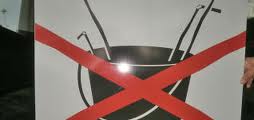
New and puzzling road signs reveils problematic drinking; 
picture courtesy of Diario de Mallorca 

Although problematic drinking is not something new, unfortunately, the old age of the drinkers was for me. And for me there is a strong socionomic smell to this phenomena.

All-in-all, my family and I had an extraordinary holiday in an extraordinary country. When I’ll write on the difficult situation in the PIIGS-countries in the coming weeks, I’ll think of Spain with much love and compassion.

Blogoria.de

Blogarchief