Search This Blog

Monday, 7 March 2011

Queen shows by visiting Sultan of Oman that she is nothing more than an expensive, but very effective marketing tool:”It all makes perfect sense”

Can't you see
It all makes perfect sense
Expressed in dollars and cents,
Pounds, shillings and pence
Can't you see
It all makes perfect sense

The Netherlands is a country with an excellent reputation on the production and export of hi-quality produce and goods:

-    Seeds, flowers and agricultural produce,
-    State-of-the-art consumer products
-    Means of production like microprocessors (NXP) and wafer machines for the chip industry (ASML)
-    Hi-tec weaponry: guns, radar installations, war ships and submarines
-    Instruments and tools for the nuclear industry 

We build it very good and we export it even better, thanks to the best marketing tool a country can have: queen Beatrix of The Netherlands. The queen is the kind of person that opens doors for the Dutch industry that remain closed for other people and countries. Although the Dutch royal family seems like a “blast from the past”, it never ceases to amaze me how effectively they can operate, as a lot of leaders are attracted by the glamour of real royalty.

It is “not our problem” that The Netherlands doesn't always look carefully at the people we deliver our goods and weapons to (Gadhaffi for instance). So it can happen that we get into a military operation against Gadhaffi, concerning the Dutch navy people currently kept hostage in Libya, only to be shot at with our own weapons. Who said that the international weapons trade is not a cynical and opportunistic business.

It is in scope of these circumstances that the next story is unfolding: the queen had planned an official state visit to Sultan Qaboos of Oman for week 10 of 2011. She would visit the desert country, accompanied by her son Willem-Alexander and daughter-in-law Maxima.

Unfortunately the societal acrimony in the Arabic world put a spoke in her wheels, as this unrest also stretched out to the country of Oman. Under some political pressure Beatrix decided to cancel the official state visit to Oman, as it was too dangerous and it could send the wrong signal to the insurgents there.

But queen Beatrix would not be queen Beatrix if she didn’t find the perfect solution in cooperation with Sultan Qaboos: the state visit would be replaced for a private dinner in the Sultan’s residence. This would keep the good relation between the Dutch royalty and the Sultan intact and everybody would be happy.

This move of the queen puzzled Geert Wilders: the populistic, pro-Israel and anti-Islam Dutch politician with big support under the lower- and middle-class white people in the large Dutch cities as Amsterdam, Rotterdam and The Hague. He was flabbergasted and spoke of a ignorant, stupid move of the queen.

Prime-Minister Rutte acted dumb and this morning it became clear why this was (De Volkskrant; link in Dutch). Here are some pertinent snips of this interesting article:

The main economic interest behind Beatrix’ visit to turbulent Oman is an expected large defense order. Dutch shipyard Damen Schelde is competing in the autocratic country for an order for the delivery of four marine ships. These aimed deliveries have a value of hundreds of millions of Euro’s.

The Dutch government announced last week that the official state visit to Oman was postponed. Queen Beatrix will now have a private dinner on Tuesday with the Sultan.[…]

The postponement of the state visit and the accompanying trade mission was a big dissappointment for Damen Schelde Shipyards. CEO René Berkvens would personally take part in this trade delegation. Moreover the Dutch Navy would direct the frigate H.M. Admiraal de Ruyter, built by Damen Schelde,  to the port of Oman capital Muscat. The queen would organize an official reception on board of the frigate. “These are very good ships of which we are extremely proud” says Damen Schelde manager Jan-Wim Dekker in the nearby country of Qatar. “Oman is very important for us”[…]

The Dutch Ministery of Foreign Affairs doesn’t see in the growing acrimony in Oman a reason to stop promoting these marine ships.According to a spokesperson at the Ministery of Foreign Affairs: “These ships are not meant for war or other wicked plans. These are meant for fighting piracy in the Arabic Gulf”.

And there you have the cynical truth: our queen and her oldest son are nothing more than expensive, but extremely effective marketing tools, used to represent and to lobby for the kind of Dutch industry where the most money is earned and the most jobs are at stake.

If the Omani government would surrender during her visit and the queen and her son would fall in the hands of the Omani insurgents, she would be one of the most expensive hostages in human history and an interesting case: do we or do we not negotiate with hostage-takers. I think that everybody with a brain knows the answer.

But luckily I guess nothing will happen during the queen’s “private” visit to Oman.
And for the next years the queen and – after her abdication – her son will receive their royal representation fees of about ten+ million Euro per year. And the Dutch industry will know that she is worth every penny of it.

And Damen Schelde will sell its marine vessels to Oman. And of course the Oman government will never use the ships against their own citizens. They promised this to the Dutch government… They really did…

Operation “Desert Mess” is turning into a total war: Arabic world is watching Libyan Civil War with terror in their hearts.

It sounded so great: the ‘peaceful’ revolutions in the countries Tunesia and Egypt promised a spring of low-violence revolutions all over the Arabic world. The old dictatorial leaders in countries like Libya, Syria and Saudi-Arabia would disappear and a kind of younger, more democratic leaders would emerge there, turning the world into a better place.

But as this dream is not fully over yet, it now seems that Libyan leader Ghadaffi is of another kind than his ‘predecessors’ Hossni Mubarak of Egypt and Tunesian leader Zine El Abidine Ben Ali.

The old Desert Fox doesn’t feel a too good person to start a war with his own people over who is in charge in the country. Was the early momentum in favor of the insurgents, now it is hard to tell who is going to win.

Gadhaffi was ruthless enough to use bomber planes, tanks and artillery against the insurgents. Now, a few weeks later, he is fighting a kind of scorched-earth strategy with bombings of civil targets and soldiers of fortune who are fighting his dirty war, attracted by the massive pay checks that Gadhaffi can afford.

As a consequence the Libyan revolution is turning into a civil war of the nasty kind:
-     With massive bloodshed under the citizens,
-     Parties that are fighting for every building and don’t take any prisoners,
-     Enormous flows of fugitives struggling to reach the shores and the borders and
-     Foreign soldiers (Dutch and English) kept hostage and shown on national TV, as a kind of war trophy.

It is uncertain how this operation “Desert Mess” ends. If Gadhaffi wins, the whole uprising in the Middle-East:
-     might fizzle out like a damp squib or
-     might make the insurgents in other countries more ruthless and determined to win their own fight.
However, if Gadhaffi loses his (final) war, he might find himself and his whole family back standing at gunpoint of a firing squad, for a departure in Nicolae Ceaucescu style. There will be no mercy then under his victors.

At this moment the rulers in all Arabian countries and even countries as far as China and Russia are grinding their teeth and wringing their hands about the ending of this Libyan war. Even today the number of uprisings in the Arabian countries is increasing and I think that the insurgents will be as determined as they can be, now they know that the price of their uprising can be plain civil war, with lots of people getting wounded and killed.

Saudi-Arabia is trying to turn the tide, by handing out some social ‘breadcrumbs’ to the people and preventing demonstrations from being organized, but it will probably be in vain.

The same goes for China that is now desperately trying to stop the massive inflation that has hit the country and the social unrest that this inflation causes. The Chinese leaders are remembering their Tiananmen Square Massacre all too well and don’t want an encore, now they try to convince the western world of their good intensions.

But all leaders in the Arabic world, Africa, Russia and China have one thing in common: they lost the contact with and understanding for their people a long time ago, as they were all living in their ivory towers, surrounded by their paladins saying how great and powerful they are.

To give you an example: as my wife is Russian, I saw the Russian news many times. I saw dozens of interviews of leaders of neighboring countries, cities and regions with Vladimir Putin and Dmitriy Medvedev. However, I never saw these leaders listening interestedly to their conversation partners. There were either speaking to their partners in a way that tolerated no objections or they were listening with a dutiful and uninterested face.

One thing is sure: when the Arabian world comes to rest again, it will have been at the cost of many, many lives. In the meantime the process will be carefully watched by the Russian and Chinese leaders.

Thursday, 3 March 2011

US Unemployment figures not expected to be much better. Dutch Unemployment figures promising, but with hidden unemployment

The USA

Tomorrow at 2.30 PM sharp the American Bureau of Labor Services (BLS) presents the latest figures about the US labor force.

Disclaimer: if you go short based on the following figures, you do it on your own risk and don’t call me when you lose money. This is an educated  guess and nothing more on my behalf!

Positive factors for the labor market:

-     The American government put through QE1 and QE2 so much money in the American economy that it should have some effects anywhere.
-     The smartphone war (Android vs Apple) and the new iPad 2 might give the consumer market a slight impuls
-     The unrest in the Middle-East can be a driver for jobs in the American energy sector

Negative factors for the labor market:
-     The unrest in the Middle-East can have a cushioning effect on growth in the making-industry, as it makes energy supply much more expensive.
-     Consumers may decide to save their money for a rainy day instead of spending it, as energy prices are exploding currently.
-     The threat of massive civil wars in the Middle-East make people feel pessimistic and pessimistic people spend less. This has a negative effect on the retail trade

My expectation: as there is still no real driver for new jobs in the American economy, the figures for February might look quite bleak. The seasonal effects of holiday season in retail are finally over now and there is still no new attitude or optimism in the labor market today. This optimism is necessary to see new opportunities. On the other hand, it is always darkest before dawn and when everybody is pessimistic, it is a great time to make money.

Combined with the unrest in the middle east and the current and future effects of this unrest on the oil and gas supply, the trend in labor will in my expectation not be positive:

-     The unemployment percentage might be a little lower to 8.9%, but I expect it to be stable at 9.0%
-     The number of added jobs has been disappointing every time over the last months. I expect it (remember: pure gutfeeling) to be disappointing too this time with less than 100,000 added jobs.
-     The current unrest in the Middle-East might be a driver for domestic jobs in the energy sector, as it might be important to be more self-supporting for the future. However, I expect this to have cushioning effects on the growth of the making-industry in the US

The Netherlands

Unfortunately The Netherlands doesn’t have a tradition of presenting the unemployment figures at the same fixed time of the month. Still I managed to grab some interesting figures from the Central Bureau of Statistics (CBS: www.cbs.nl) about the unemployment situation in The Netherlands

Figure 1: Unemployment ratings
See figure 1: Since about 1.5 years the unemployment is quite stable between the 5% and 6% with a positive exception in September 2009 due to seasonal influences. The trend is going down as the export to the European countries is increasing. The trend for people receiving Unemployment Benefit is also quite stable.

Figure 2: Welfare payments to persons up to 65
The trend for people receiving social welfare is higher in general (see figure 2) and there is a relative stronger increase at people under 35 (see figure 3). This means that the category starters on the labor market that want a job, but don’t have it is growing. As they have little or no labor history, they don’t receive (much) UB.

Figure 3: Welfare payments per age category
The tricky thing with these young people is that they have:
-     Little experience in the labor market, which is a definite disadvantage for getting a job in the future, as they are aging
-     A black hole in their resumee, which no future employer will like: the double-whammy in this situation.
-     A big chance of falling in the poverty trap as an effect of the first two bullets: receiving welfare without having a chance of getting out of it. This might result in a “lost generation”.

So although the unemployment in The Netherlands is relatively low with only about 5%, there are a few ‘buts’ in these figures. The first is the growing low-aged social welfare population that has less chances on the labor market for the future.

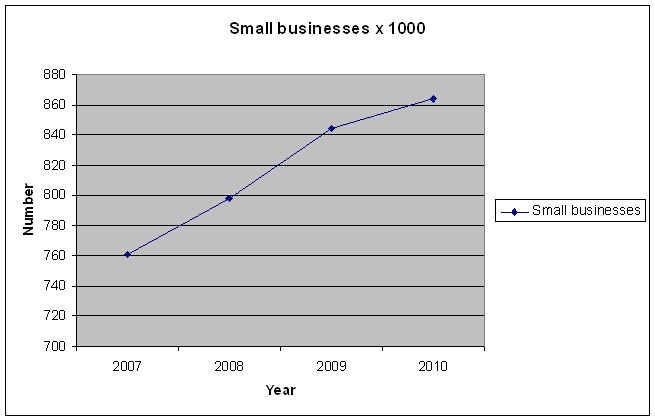
The 2nd but is: Over the last years there was a trend, especially in the IT and the building (materials) branch of trade, to push people towards flexible contracts, temporary employment and especially freelancing. Although stimulated by the government, it was mainly a push by the employers in these businesses. If these temporary workers and freelancers have no jobs or contracts, due to the problems and stagnation in the building sector or disappearing jobs in the banking sector, they will be unemployed without being in the official unemployment figures. They cannot claim Unemployment Benefit and even claiming social welfare is impossible without liquidating their possessions. This might be a 2nd poverty trap (see figures 4 and 5)

Figure 4: small business in The Netherlands

Figure 5: small businesses per trade category
All-in-all the Dutch Unemployment figures are not bad at all, but we should beware of the hidden traps in it. For the USA in my opinion the chance for disappointing figures is greater than the chance for uplifting ones.

Blogoria.de

Blogarchief