Search This Blog

Saturday, 14 January 2012

Standard & Poor's negatively adjusts ratings of nine Euro-zone countries. France and Austria lose their AAA-rating


This evening, after the New York stock exchange closed, Standard and Poor´s presented its rating adjustments for the countries in the Euro-zone. This was an expected move as all countries had been put on Creditwatch negative at 5 December 2011.

Maybe the biggest surprise was that Germany maintained its AAA-rating with an outlook stable. Although the AAA-rating was no surprise, the stable outlook was. Only two countries have a stable outlook for the coming years: Germany and Slovakia, of which Slovakia was downgraded one notch.

Two countries lost their treasured AAA-rating: Austria and France. Austria lost it probably due to its heavy involvement in Hungarian sovereigns, while France had to pay the price for the problems with the French banking industry. The three French system banks (G-SIFI) BNP Paribas, Crédit Agricole and Dexia are all three in deep financial trouble. Therefore S&P´s downgrade of France was expected by the market.

Here are the pertinent snips from the Standard and Poor's press release
In our view, the policy initiatives taken by European policymakers in recent weeks may be insufficient to fully address ongoing systemic stresses in the eurozone.

We are lowering our long-term ratings on nine eurozone sovereigns and affirming the ratings on seven.

We have lowered the long-term ratings on Cyprus, Italy, Portugal, and Spain by two notches; lowered the long-term ratings on Austria, France, Malta, Slovakia, and Slovenia, by one notch; and affirmed the long-term ratings on Belgium, Estonia, Finland, Germany, Ireland, Luxembourg, and the Netherlands.

The outlooks on the long-term ratings on Austria, Belgium, Cyprus, Estonia, Finland, France, Ireland, Italy, Luxembourg, Malta, the Netherlands, Portugal, Slovenia, and Spain are negative.

The outlooks on the long-term ratings on Germany and Slovakia are stable.

Today's rating actions are primarily driven by our assessment that the policy initiatives that have been taken by European policymakers in recent weeks may be insufficient to fully address ongoing systemic stresses in the eurozone. In our view, these stresses include: (1) tightening credit conditions, (2) an increase in risk premiums for a widening group of eurozone issuers, (3) a simultaneous attempt to delever by governments and households, (4) weakening economic growth prospects, and (5) an open and prolonged dispute among European policymakers over the proper approach to address challenges.

The outcomes from the EU summit on Dec. 9, 2011, and subsequent statements from policymakers, lead us to believe that the agreement reached has not produced a breakthrough of sufficient size and scope to fully address the eurozone's financial problems.

We also believe that the agreement is predicated on only a partial recognition of the source of the crisis: that the current financial turmoil stems primarily from fiscal profligacy at the periphery of the eurozone. In our view, however, the financial problems facing the eurozone are as much a consequence of rising external imbalances and divergences in competitiveness between the eurozone's core and the so-called "periphery". As such, we believe that a  reform process based on a pillar of fiscal austerity alone risks becoming self-defeating, as domestic demand falls in line with consumers' rising concerns about job security and disposable incomes, eroding national tax revenues.

We believe that the main downside risks that could affect eurozone sovereigns to various degrees are related to the possibility of further  significant fiscal deterioration as a consequence of a more recessionary macroeconomic environment and/or vulnerabilities to further intensification and broadening of risk aversion among investors, jeopardizing funding access at sustainable rates.

Here is an overview of the rating changes ( I don´t take any responsibility for typing errors, by the way – EL).

Overview new and old ratings after S&P ratings adjustment
All data courtesy of: http://www.standardandpoors.com/
Click to enlarge
I can´t blow a hole in S&P´s argumentation and – more important – none of the European leaders can. What they did in December was too little, too late and everybody knew that within two days.

The fact that France and Austria are downgraded from AAA to AA+, makes it even harder to maintain the AAA-rating of the EFSF (European Financial Stability Facility).The rating of this emergency fund now depends on the guarantees of only four countries with an AAA-rating: Germany, The Netherlands, Luxembourg and Finland.

And that is a very heavy burden to carry for only four countries of which three have very narrow shoulders, financially speaking.

Friday, 13 January 2012

The Euro-zone presented an export surplus for November 2011, in spite of the credit crisis blazing up


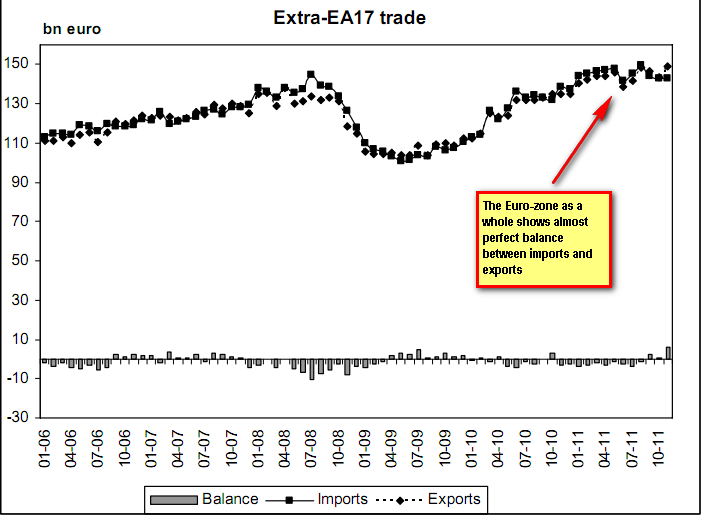
Today, the European bureau for statistics ‘Eurostat’ presented the November 2011 trade data for the Euro-zone and the whole European Union. From a Euro-zone point of view the data was surprisingly good: The Euro-zone achieved in November an export surplus of €6,9bln. 

The whole EU-27 had a deficit of €7.2bln for November 2011. Here are the pertinent snips from Eurostat (ec.europa.eu/eurostat).


7.2 bn euro deficit for EU27

The first estimate for euro area (EA17) trade with the rest of the world in November 2011 gave a 6.9 bn euro surplus, compared with -2.3 bn euro in November 2010.

The October 2011 balance was +1.0 bn, compared with +3.1 bn in October 2010. In November 2011 compared with October 2011, seasonally adjusted exports rose by 3.9%, while imports remained stable. The first estimate for the November 2011 extra-EU27 trade balance was a 7.2 bn euro deficit, compared with -16.8 bn in November 2010. In October 2011 the balance was -11.2 bn, compared with -9.5 bn in October 2010.

In November 2011 compared with October 2011, seasonally adjusted exports rose by 2.8%, while imports fell by 0.6%.

EU27 detailed results for January to October 2011

The EU27 deficit for energy increased significantly (-317.5 bn euro in January-October 2011 compared with -246.4 bn in January-October 2010), while the surplus for manufactured goods rose notably (+198.9 bn compared with +136.4 bn).

EU27 trade with all its major partners grew in January-October 2011 compared with January-October 2010, except for imports from South Korea (-8%). The highest increases were recorded for exports to Russia (+28%), Turkey (+23%), China (+21%) and India (+20%), and for imports from Russia (+26%), Norway (+21%), Brazil and India (both +20%).

The EU27 trade surplus increased slightly with the USA (+60.8 bn euro in January-October 2011 compared with +60.1 bn in January-October 2010) and more significantly with Switzerland (+24.1 bn compared with +16.6 bn) and Turkey (+21.3 bn compared with +14.7 bn).

The EU27 trade deficit fell with China (-132.2 bn compared with -139.8 bn),  Japan  (-16.1 bn compared with -18.3 bn) and  South Korea  (-3.9 bn compared with -9.6 bn), but increased with Russia (-76.0 bn compared with -61.1 bn) and Norway (-38.7 bn compared with -29.8 bn).

Concerning the total trade of Member States, the largest surplus was observed in Germany (+129.2 bn euro in January-October 2011), followed by Ireland and the Netherlands (both +35.9 bn) and Belgium (+10.1 bn). The United Kingdom (-98.2 bn) registered the largest deficit, followed by France (-72.5 bn), Spain (-40.1 bn), Italy (-24.2 bn), Greece (-16.9 bn), Portugal (-13.3 bn) and Poland (-12.0 bn).

In general you could say that the data looks surprisingly good for the Euro-zone and not too bad for the EU27 as a whole. Net exporters where it concerns total trade within and outside Europe for the period January until October 2011 are the usual suspects Germany, Ireland, The Netherlands and Belgium.

Negative outliers are the UK and France with huge export deficits of respectively €-98.2 bln and €-72,5 bln for the period January until October, while the PIIGS (minus Ireland, of course) and Poland also have substantial deficits.

But you see funny differences if you zoom in at the tables that were delivered with the press release, especially when you look at The Netherlands in the following two tables.

Total imports and exports within and outside the EU for the EU-27
Table courtesy of Eurostat: ec.europa.eu/eurostat
Click to enlarge
Where it concerns total trade inside and outside the EU, The Netherlands is a huge net exporter with a trade surplus of €35.9 bln (see first table).

Total imports and exports outside the EU for the EU-27
Table courtesy of Eurostat: ec.europa.eu/eurostat
Click to enlarge
But when it comes to trade outside the EU alone in October 2011 and November 2011, The Netherlands is the biggest net importer with a trade deficit of €-9 bln (see second table).

This is not as strange as it seems initially, as The Netherlands has two very large sea ports with Rotterdam and Amsterdam (number 1 and 3 on the list of largest ports in Europe in turnover) and a very important cargo airport with Schiphol.

Therefore The Netherlands is the main distribution point for imports from outside the EU and especially from the Far East. The import surplus from outside the EU is turned into an export surplus within the EU. In this case, you could say that the more negative the number in the last table is, the better the Dutch´ distribution function has operated. This is not true for the second largest net importer from outside the EU: the United Kingdom.

When imports and exports outside the EU are weighted for the Euro-zone alone, the Eurozone has almost been in balance during the last years. This is especially caused by Germany with its enormous net exports outside the European Union.

Trade of the Eurozone with countries outside EU
Data courtesy of Eurostat: ec.europa.eu/eurostat
Click to enlarge
The European Union as a whole has been a huge net importer for countries outside the EU during the last years. This is mainly caused by The Netherlandsthe countries of the former Eastern Block and the UK.

Trade of the EU-27 with countries outside EU
Data courtesy of Eurostat: ec.europa.eu/eurostat
Click to enlarge


Thursday, 12 January 2012

Mass lay-offs in the banking world… and at other companies


Already on April 26 of 2011, I noticed a trend towards mass lay-offs in The Netherlands in my article Three recent trends in The Netherlands:

It could be that these job cuts are the beginning of a more serious trend towards less employment. I wrote a number of columns mentioning the Part time Unemployment Benefit (PUB). This was a 50% government subsidy on salaries for companies to keep people employed that had too little work. In this way the companies could keep experienced personnel on the payroll until better days arrived.

What I had against this PUB is that companies that made use of it, missed the chance to become ‘lean and mean’ again. They gathered their personnel in the 2000’s:  while there was a situation of excess consumption in the USA and Europe, this also caused excess production. This excess consumption came to a sudden halt in the year 2008 in Europe and it is improbable that this excess consumption will return within a few years.  By keeping your personnel at an excess level, you run the risk of returning to red marks as soon as the economy chokes again.

Since then the number of mass lay-offs has only been increasing, as I described in a number of articles:
Today there was news concerning mass lay-offs in the banking industry. According to Reuters, a mindboggling number of 133,500 employees in the banking industry has already been laid off or will be laid off shortly.

And while the lay-offs at the Dutch banks Rabobank, ABN Amro and ING Groep NV (IDG.N) were already mentioned in my previous blogs, other banks are also taking desperate measures to improve their capitalization and reduce costs. The following list comes from an article in the India Times and is based on a list put together by the Reuters press agency.


List of mass lay-off among the largest banks of the world
www.indiatimes.com
Click to enlarge
Reuters itself writes a story on the lay-offs at the British system bank Royal Bank of Scotland Group PLC (RBS). Here are the pertinent snips:


Royal Bank of Scotland abandoned ambitions to be a top global investment bank and said it would cut another 4,450 jobs as it bows to pressure from the UK government to shut down risky operations and prepare for tougher international regulations.

Britain owns 83 percent of Britain's fifth biggest bank after pumping in 46 billion pounds to keep it from going under during the financial crisis and the country's taxpayers are currently sitting on a 24 billion pound loss.

The government has demanded that RBS shrink its investment bank further, despite the bank already halving that part of its business over the last three years.

RBS will now stop trading shares and advising companies on takeovers, both loss-making businesses, in arguably the starkest retreat by a big investment bank as the financial crisis and tough new rules hit profits across the industry.

RBS said it is cutting 3,500 jobs in its investment bank and will exit cash equities, corporate broking, equity capital markets and mergers and acquisitions businesses. The cuts come on top of 2,000 at the investment bank in the second half of 2011 and account for more than a quarter of the unit's staff.

In total the bank has cut 34,000 jobs since Chief Executive Stephen Hester was brought in to turn the bank around when it was bailed out in 2008. The Unite trade union said that 22,000 of those jobs were in the UK alone.

But a massive loss of jobs was not exclusively for the banking business today. Also in the retail industry there was bad news from the British supermarket chain Tesco PLC (TSCO.L) and its Belgian counterpart Delhaize (DELB.BR). Again Reuters:


Tesco, Britain's biggest retailer, reported its worst Christmas sales performance for decades on Thursday and warned it would see minimal profit growth next year as it invests in winning back shoppers.

The world's third-largest stores group said on Thursday it now expected minimal trading profit growth for 2012/13 against analysts' forecasts for a 10 percent increase. It will cut back large store openings, while investing in the internet.

The supermarket group, which makes about 70 percent of operating profit in Britain, said sales at UK stores open over a year fell 2.3 percent excluding fuel and VAT sales tax in the six weeks to Jan. 7.

"We are disappointed with our seasonal trading performance in the UK," Chief Executive Philip Clarke said.

"In a challenging consumer environment at home, and with early signs of more cautious behaviour emerging elsewhere, we have seen more strain than anticipated on our profitability during the important seasonal trading period."

Tesco didn’t announce yet that jobs will disappear in the coming months, but if you read between the lines (‘It will cut back large store openings, while investing in the internet’), it makes sense that jobs in the bricks-and-mortar stores are on the line.

However, a supermarket chain that did state that jobs will disappear at short notice, is Brussels, Belgium based Delhaize:


Belgian supermarket group Delhaize (DELB.BR) plans to cut 5,000 jobs after fourth-quarter sales fell just short of expectations in its key United States and Belgium markets, due to the weak consumer sentiment and price competition.

Delhaize, which makes about 65 percent of its revenue in the United States, said on Thursday it would cut close 113 underperforming stores there and a further 20 convenience stores and supermarkets in Bulgaria, Serbia and Bosnia & Herzegovina.

Delhaize America, which has more than 1,600 stores in 16 states in the eastern United States, also operates under the banners Bottom Dollar Food, Harveys, Hannaford Supermarkets, Reid's and Sweetbay.

All affected stores will close within 30 days and store conversions will begin immediately, the company said.

The company said that fourth-quarter revenue rose by 7.0 percent at identical exchange rates to 5.64 billion euros ($7.16 billion), below the average 5.68 billion euros expected in a Reuters poll of 11 brokers.

Also in The Netherlands – my home country – there was bad news concerning cutbacks and future job losses at various companies.

The Dutch financial newspaper Het Financieele Dagblad (www.fd.nl) writes on Dutch publisher Wegener, an 86% investment of the British company Mecom Group PLC (MEC.L)


Dutch publisher Koninklijke Weger foresees a round of job cuts later this year. The company also assesses the possibility for further austerity measures.

These measures are the consequence of lagging company results over 2011. This is stated by the company in a trade update, without mentioning concrete plans. Last year Wegener saw its gross result decline to €60 mln from €62.3 mln, a drop of 3.7%. Sales dropped with 3%, according to the company and is now set at about €508 mln. Wegener’s 2010 sales was still €523,6 mln.

A transformation process of the company ‘towards a new organization’ didn’t yield the demanded results. Therefore a ‘structural decrease of personnel numbers’ was inevitable.

Reuters writes on the French-Dutch aviation company Air France KLM SA (AFRAF.PK) planning massive cutbacks to the tune of €2 bln and (perhaps) future job losses.

Air France-KLM announced a pay freeze for French staff and cutbacks in its fleet as part of a three-year plan to end financial rot at Europe's largest airline by revenues.

The Franco-Dutch group pledged to cut debt by 2 billion euros ($2.56 billion) by end-2014 and said it would shrink its fleet by shedding more than a billion euros from a planned expansion project.

The plan will also involve a combination of immediate and longer-term cost reduction measures, Air France-KLM said in a statement on Thursday.

"We needed to take these measures because our debt position and costs per unit were running too high, and because of losses on our domestic and European routes ... We do this to avoid getting into trouble later," said Peter Hartman, chief executive of KLM, the group's Dutch subsidiary.

Shares in the group rose over 7 percent earlier as investors bet on firm action from Jean-Cyril Spinetta, restored as chief executive in addition to his role as chairman last November, following months of underperformance compared to its rivals.

Unions are expected to hit back at the plan which calls for a general pay freeze at Air France during 2012 and 2013 combined with "wage moderation" at the Dutch sister airline KLM.

The measures are part of a 1 billion euro package of immediate cost cuts that also include a continued hiring freeze.

In a spoken statement on the Dutch Business News Radio (www.bnr.nl) chairman Peter Hartman of KLM stated that job losses for the time being will be reduced to temporary personnel from external agencies, whose jobs won’t continue in the coming months. But you may expect AF/KLM to also cut in their own personnel numbers, directly after the French elections.

It promises to be a cruel, cruel summer in the coming months of 2012.

Update 13 January 2011


Already today the Dutch publisher Wegener presented the exact impact of its planned job cuts for 2012. The company wants to lay-off a maximum of 10% of its personnel. According to the Dutch newspaper De Stentor ´the range of job cuts lies between 200 and 280 jobs'. 

Blogoria.de

Blogarchief